Planning a city tour in Tirana is exciting because you’ll be able to comfortably cover several major attractions, including historical sites, vibrant neighborhoods, and scenic spots. Self-driving lets you explore the best places to visit in Tirana at your own pace without waiting for buses or taxis. It’s a convenient way to start sightseeing, especially if you’re new to the city. If you rent a car in Tirana, this itinerary will help you maximise your time while avoiding unnecessary detours and traffic hassles.
Tirana is a relatively small capital, but driving here has its quirks. Here are a few practical tips before you hit the road:
Driving in Tirana is straightforward once you know the basics, especially if you're exploring Tirana attractions by car. You’ll need a valid driving licence, and while some companies accept a regular home-country licence, having an International Driving Permit is the safest option.
Most rental agencies require drivers to be at least 21 years old, and those under 25 may face a young-driver surcharge. A credit card in the main driver’s name is mandatory because agencies place a security deposit on it. This deposit is a standard procedure and is released once you return the car in good condition.
Rentals often come with only basic insurance, so travellers can choose full coverage for added peace of mind. Before leaving the lot, thoroughly inspect the car and take photos or videos of any scratches, dents, or interior marks to document everything.
Tirana’s roads are lively. Locals drive assertively, switching lanes quickly and using the horn liberally, so stay alert and maintain a safe distance. Traffic moves on the right-hand side, and roundabouts are very common.
Patience is important because congestion can build up around central areas. Navigation apps work well and help you avoid unexpected traffic hotspots. Planning your route around rush hours, from 7:30 to 9 AM and 4:30 to 6:30 PM, will make driving smoother, especially if you're hopping between museums, parks, or viewpoints.
Parking in Tirana is manageable when you understand the system. Streets with white lines allow parking, which are free or sometimes metered. Yellow lines mean no parking. The city centre includes paid zones. For example, Zone A may cost around 100 Lek/hour, so keep some coins handy in case a meter doesn’t take cards.
There are several options, including underground parking beneath Skanderbeg Square, which places you conveniently near many top sights. After 8 PM, most central street parking becomes free until morning, making evening visits especially convenient.
This route takes you through Tirana’s most character-rich areas. Along the way, you’ll experience the city’s contrasts up close, from monumental squares and hidden bunkers to lakeside paths and mountain views.
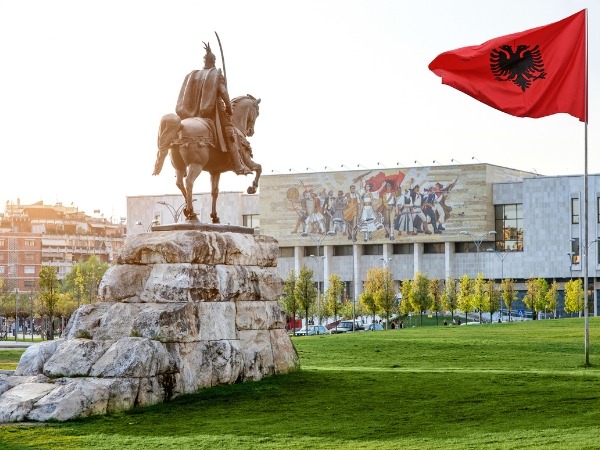
Stop 1 is a natural starting point at the heart of the city and one of the best places to visit in Tirana. You can easily arrive here by car, as an underground parking facility is located directly beneath the plaza. Once you park, you can step into Skanderbeg Square, a vast pedestrian space named after Albania’s national hero Gjergj Skanderbeg. You can spend around 45 to 60 minutes exploring the landmarks that surround it. The square is one of the largest car-free plazas in the Balkans, ideal for walking, taking photos, and orientation.
Skanderbeg Square is framed by some of Tirana’s most iconic sites, all within a few steps of each other. At its centre stands the Skanderbeg Monument. To one side is the Et’hem Bey Mosque, a beautifully preserved Ottoman-era mosque known for its rare interior frescoes.
The Clock Tower rises just beside it as one of the city’s historic symbols. On the opposite side, the National History Museum is instantly recognizable by its giant mosaic facade depicting Albania’s struggles and triumphs through the ages. Collectively, these landmarks represent the layers of Tirana’s cultural identity.
Because Skanderbeg Square is both central and highly walkable, it is the perfect orientation hub for the rest of your driving itinerary. Roads radiate outward in all directions. When you’re ready to continue, your next stop is about 300 metres, which takes just 2 to 3 minutes by car. You can walk instead to avoid re-parking for such a short distance.
Bunk’Art 2 offers one of the most striking contrasts to the lively city above. Set inside an actual Cold War–era bunker, this underground museum provides a look into Albania’s communist past and its internal security machinery.
You’ll walk through dim corridors and reinforced concrete rooms that once served as a secret shelter. The exhibits give a clear, technical insight into how the Ministry of Internal Affairs and the Sigurimi secret police monitored and controlled everyday life. Through photographs, artifacts, reconstructed rooms, and emotional video installations, the museum reveals how deeply surveillance and political persecution shaped the country’s recent history.
Because Bunk’Art 2 is small and well-organised, you can explore it in 30 to 45 minutes. This museum stands out among Tirana's attractions, offering a vivid immersion into Albania’s Cold War era. When you exit the bunker and step back into the noise and colour of modern Tirana, the contrast is striking. It sets the stage for your next stop, the upbeat cafés and nightlife of Blloku.
Blloku is one of the best places to visit in Tirana if you want to experience the city’s modern, stylish side. During the communist era, Blloku was an exclusive residential zone for the ruling elite, closed off to ordinary citizens and guarded heavily. Even Enver Hoxha’s former villa still stands here, a silent reminder of that past. Today, the area has reinvented itself as a lively hub filled with cafés, bars, boutique shops, and colourful buildings.
Parking in Blloku is usually curbside or in small paid lots, so look for signs or metres before leaving your car. Once parked, take your time wandering the pedestrian-friendly streets, where you’ll find everything from cosy coffee spots to modern restaurants. This is one of the best districts in the city to enjoy a relaxed coffee break or lunch while people-watching.
You’ll also notice street art, murals, and creatively painted buildings, all part of Tirana’s growing design and art scene. If the neighbourhood’s history interests you, stroll down Ismail Qemali Street to see Hoxha’s villa from the outside. It’s a modest three-storey building now surrounded by the energy of the city he once controlled.
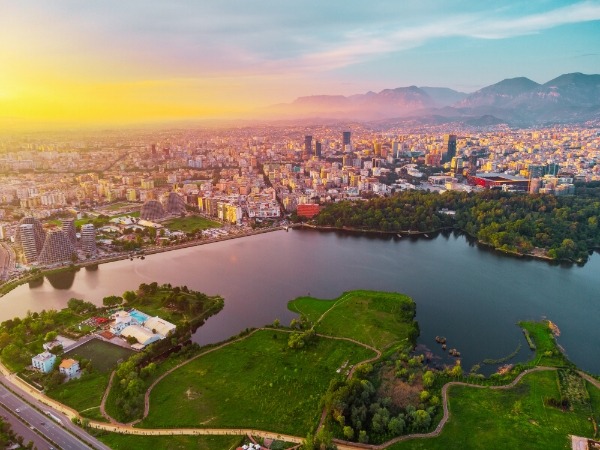
Stop 4 is your chance to slow down and enjoy some greenery when sightseeing in Tirana. The Grand Park of Tirana (Parku i Madh) is a vast urban oasis centred around the artificial lake, offering a refreshing contrast to the busy streets you explored earlier. It’s one of the city’s favourite recreational spaces, perfect for a mid-day pause, a scenic walk, or a relaxed lakeside lunch.
As you drive into the park area, you’ll find curbside parking along the loop road that circles the lake. Parking is manageable on weekdays, though weekends can be livelier as families and joggers flock to the area. Once you’ve left the car, stroll down the shaded footpaths leading toward the lake.
The atmosphere is calm and restorative, with locals jogging, couples walking, and students relaxing under the trees. The lake creates a cooling breeze, and the reflections of the treeline on the water make this one of the most peaceful corners of Tirana.
For lunch, you have plenty of options. Several lakeside cafés and restaurants offer everything from traditional Albanian dishes to Italian-style meals, all with lovely water views. If you’d prefer a casual meal, pick up a pastry or sandwich and enjoy a simple picnic on the grass beneath the trees. With more than 230 hectares of parkland, it’s easy to find a quiet spot to unwind.
After eating, take a walk along the lakeside paths. You might pass anglers waiting patiently at the water’s edge, kids playing near the lawns, or memorials and statues tucked between the trees. There’s a corner of the park with historically significant graves and a small open-air theatre.
Stop 5 brings you to the northeastern edge of the city, right at the foot of Mount Dajti, where Bunk’Art 1 offers one of the most immersive historical experiences in Tirana. This is the larger, original Bunk’Art museum, built inside a colossal Cold War–era bunker that once served as a secret shelter for Enver Hoxha’s government.
Designed to withstand wartime attacks, the bunker descends multiple levels underground and contains more than 100 rooms spread across five floors, making it one of the most unusual museums in Albania.
Driving toward the Dajti area, you’ll spot signs leading you to the museum near the Dajti Ekspres cable car base station. There is a parking area close to the entrance. Once inside, you enter dimly lit corridors that transport you back to Albania’s communist era. The museum spans the period from World War II to the fall of the dictatorship, featuring historical exhibits, preserved rooms, archival footage, and atmospheric audio installations.
You’ll wander through officers’ quarters, communication rooms, long blast-proof hallways, and even the dictator’s private suite. Some areas feature artistic interpretations of life under total surveillance and the political paranoia that led to thousands of bunkers being built across the country.
The scale of Bunk’Art 1 makes it fascinating and haunting. Unlike Bunk’Art 2, which focuses more on the secret police, this museum presents the broader story of Albania’s 20th-century upheavals. Your next and final stop sits just up the mountain. You can either walk a few minutes to the Dajti Ekspres cable car or drive up the mountain road.
Stop 6 takes you out of the city and into the fresh mountain air of Mount Dajti, the perfect final stop for a day of sightseeing in Tirana. Known as “Tirana’s balcony” for its sweeping panoramic views, Mount Dajti offers a peaceful escape where you can unwind, enjoy nature, and take in vistas stretching from the city centre all the way to the Adriatic.
You can reach the mountain either by car or via the Dajti Ekspres cable car, which is right next to Bunk’Art 1. The cable car is the most scenic route, carrying you 4.5 kilometres up the mountainside. It is one of the longest cable-car rides in the Balkans, while offering unbeatable views over Tirana’s urban grid, forested slopes, and distant coastline.
The ride takes about 15 minutes and lifts you to roughly 1,050 metres elevation, placing you near the upper zone of the national park. Cabins are fully enclosed and comfortable. Just be sure to check the return schedule so you don’t ride up too close to the day’s final departure.
If you’d rather drive, the road up to Dajti winds through forested hills and takes about 20 minutes from the bunker area. The road is paved but narrow in places, so take your time around bends. Once at the top, you’ll find small parking areas near restaurants, viewpoints, and open green spaces.
No matter how you ascend, the reward is stunning panoramas and a refreshing change of pace. You can see Tirana spread out like a map, the Sky Tower in the distance. On a clear day, even the shimmering Adriatic Sea is far beyond. At the upper station, you’ll find cafés and restaurants.
To give you a summary of the day’s journey, here’s an overview of the distances and time spent:
By following this itinerary, you’ve experienced a cross-section of Tirana. The route flows naturally through the city, where you can dive into history at museums and then come up for air in the park and on the mountain. Tirana is a city of surprises, so as you drive between stops, you will likely notice colourful buildings, roadside markets, and daily life unfolding in this capital.
If this itinerary inspired you, renting a car in Tirana with Final Rentals is the next step. Select your pick-up location in Tirana International Airport or downtown, enter your travel dates, and choose a vehicle for your trip. Book and manage your car rental at any time. Download the Final Rentals app on Google Play and the App Store.